Forma AI
Requirements, agent handoffs and human acceptance.
AI project management and Codex execution workbench
Nov 2026 – Present · Dates per resume
Product architecture · Workflow design · Test coordination
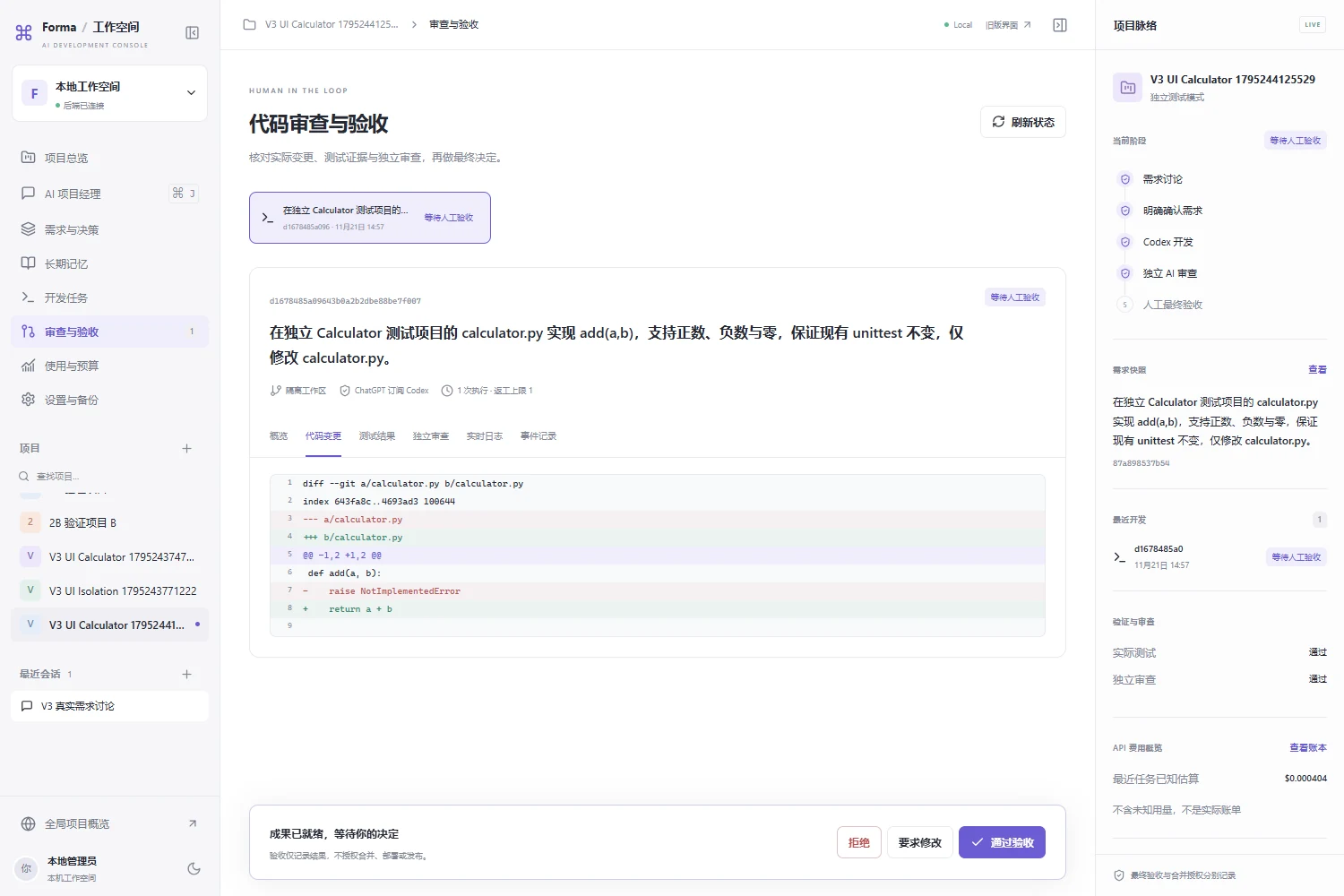
Completed requirements, authorization and task scheduling, agent collaboration and codex execution, project context and long-term memory, code review, testing and human acceptance.
Project completion and usability confirmed by the portfolio owner. Screenshots and recordings retain their original capture context.
Completed requirements, authorization and task scheduling, agent collaboration and codex execution, project context and long-term memory, code review, testing and human acceptance.
Completed and available for use.
Ongoing maintenance and improvements based on usage feedback.
What I Built
Completed requirements, authorization and task scheduling, agent collaboration and codex execution, project context and long-term memory, code review, testing and human acceptance.
How It Works
Project context → frozen task → authorized execution → diff and test review → human acceptance.
My Contribution
Product architecture · Workflow design · Test coordination
Technical Challenges
Project context, requirement versions and authorization across agent handoffs.
Testing & Validation
Development included workflow testing, output review and troubleshooting.
Current Status
Completed · Ready to use
Evidence & implementation boundaries
Project completion and usability confirmed by the portfolio owner. Screenshots and recordings retain their original capture context.
The product is complete and usable, as confirmed by the portfolio owner. Responsibilities and dates follow the supplied resume; screenshots, recordings and logical diagrams illustrate the work.
Original resume project name: Forma AI 智能开发工作台|AI 项目经理与 Codex 自动化开发系统
Overview
Forma organizes AI-assisted development around explicit requirements, project context and reviewable task handoffs. It connects an AI project manager with Codex execution and keeps human authorization and acceptance in the workflow.
Completed requirements, authorization and task scheduling, agent collaboration and codex execution, project context and long-term memory, code review, testing and human acceptance.
Development included workflow testing, output review and troubleshooting.
Completed and available for use.
Ongoing maintenance and improvements based on usage feedback.
Problem
AI-assisted development can scatter requirements across conversations, mix project context and leave task progress difficult to audit. A code change or passing test also does not, by itself, establish that a user has accepted the result. Forma brings these handoffs into a project workbench.
My Role
I led product requirements, architecture and workflow design, defined the division of work between the AI project manager and Codex, and coordinated testing and defect review. GPT and Codex assisted implementation and debugging; I do not claim to have independently handwritten the entire codebase.
Key Decisions
Separate planning from execution
The AI project manager clarifies scope and organizes tasks; Codex changes code and runs tests. This makes each handoff reviewable rather than treating one chat reply as the complete development process.
Freeze scope before scheduling execution
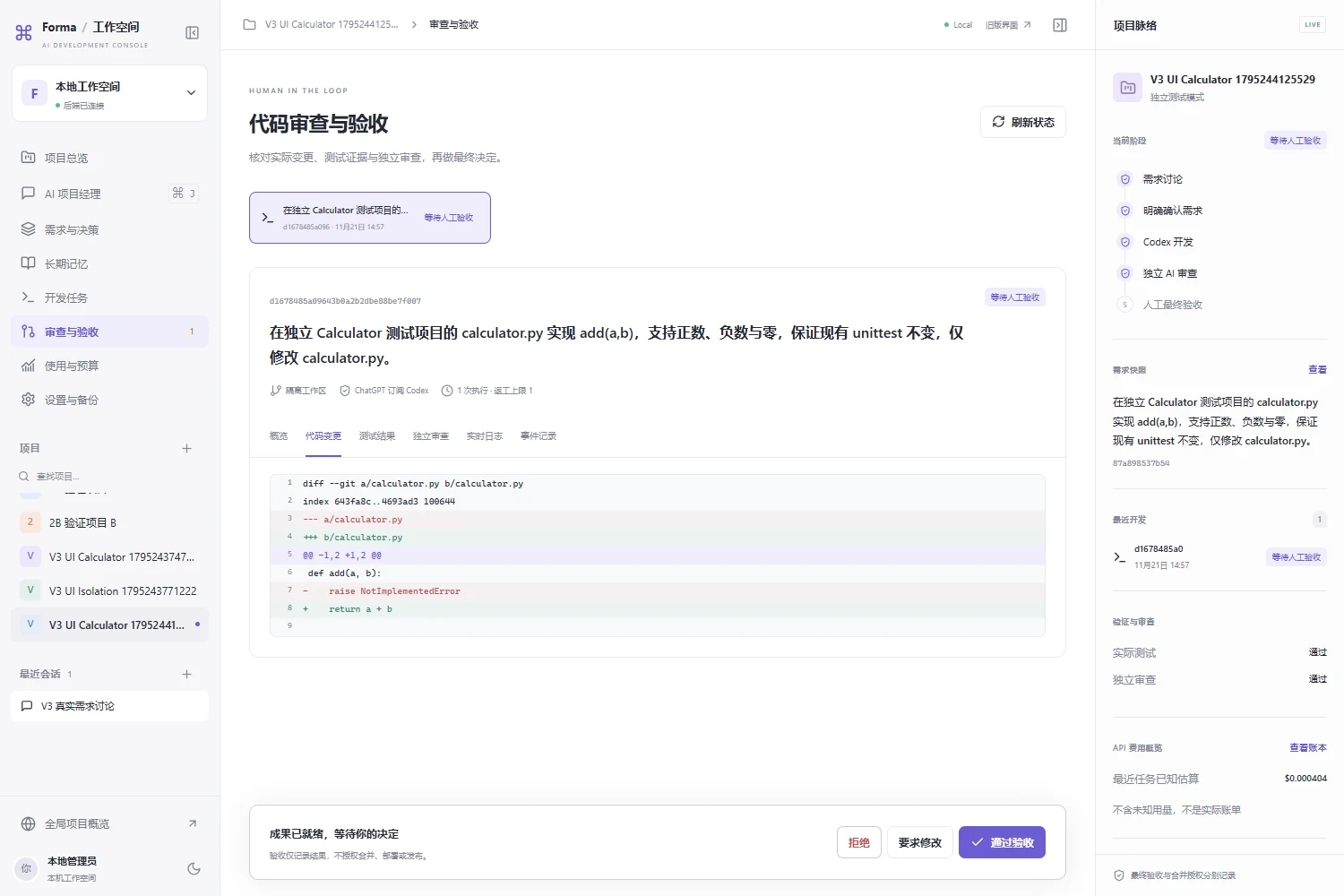
Confirmation, version freeze and authorization precede the execution task. Saved changes and test results support review; final UAT remains a separate human decision. This is a task lifecycle, not a claim of production-scale distributed scheduling.
Keep context local to the project
Project isolation, persisted conversations and history retrieval are resume-reported design work.
Product Design
Organize work around a project-scoped conversation, a confirmed requirement version and an explicit execution task. Keep planning, execution, review and human acceptance distinct so a task can be traced back to the scope that authorized it.
Inside the product
Supplied media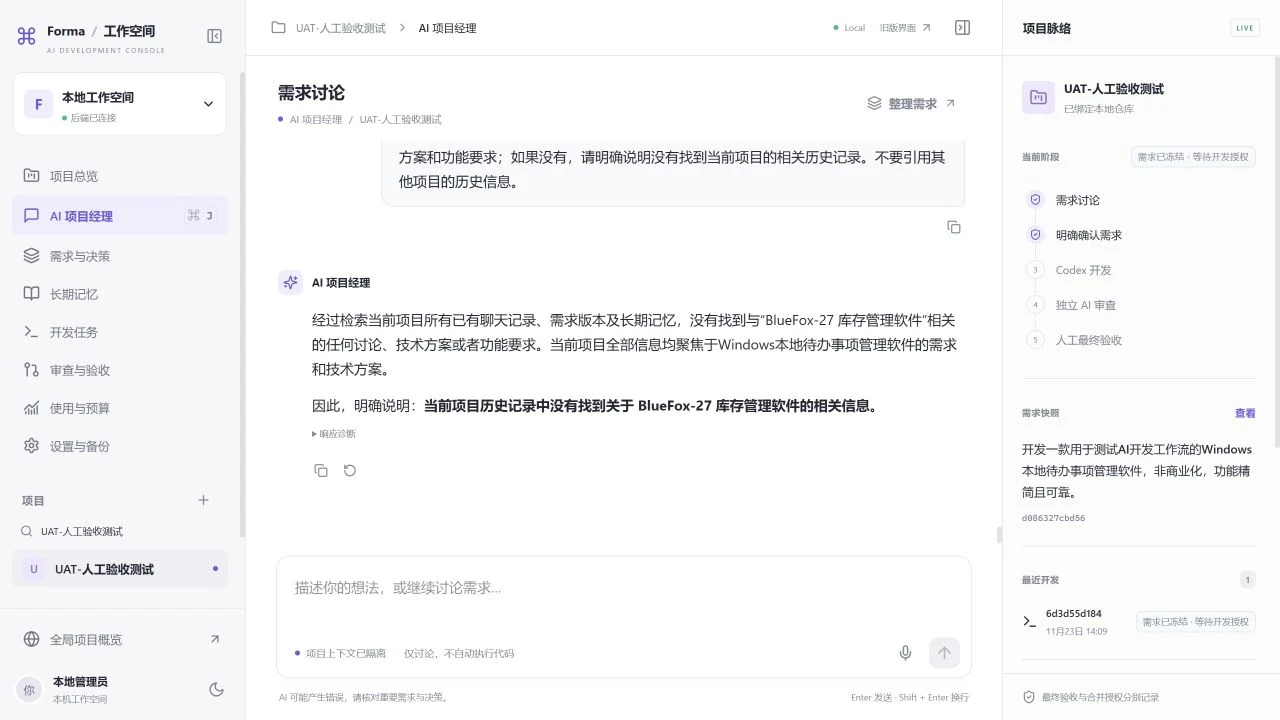
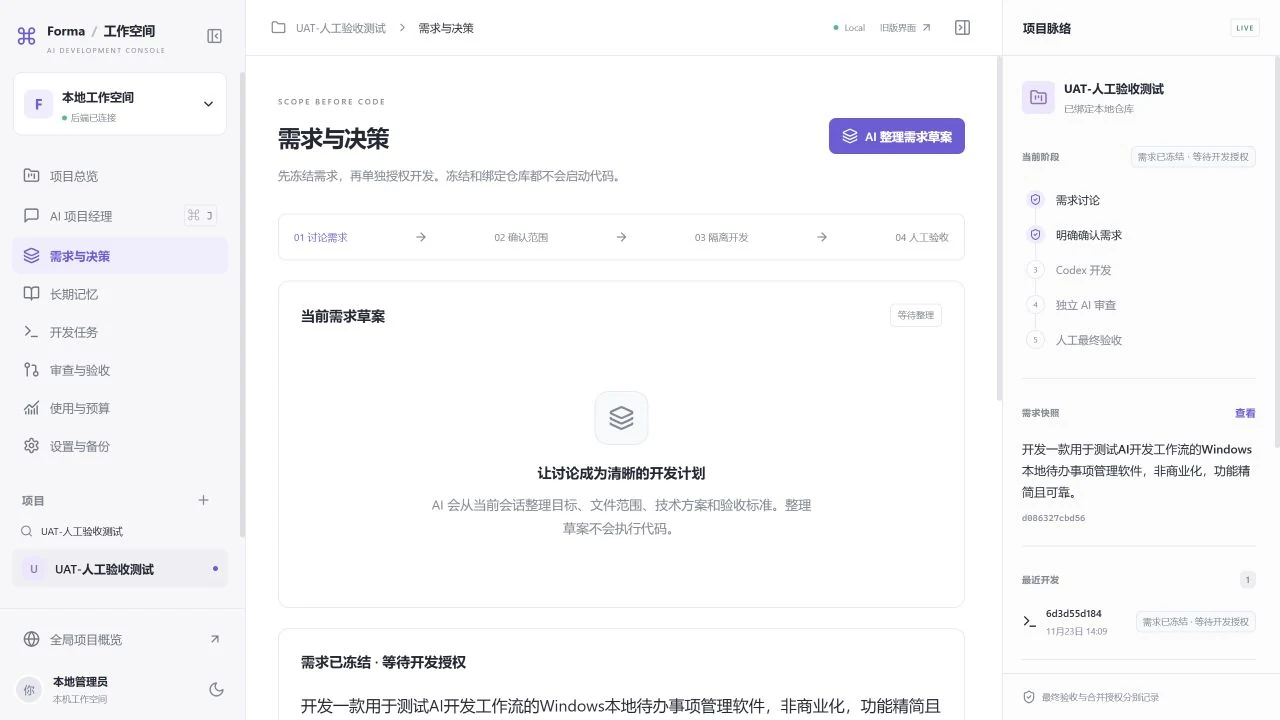
System Architecture
Logical design: project context and conversation history feed requirement analysis; a frozen requirement and human authorization govern Codex execution; changes and saved tests feed review and UAT. Long-term memory retrieval is a design track, not a fully accepted subsystem.
- Project contextSystem workflow
- Requirement & taskSystem workflow
- Human authorizationHuman decision / review
- Codex executionSystem workflow
- Tests & human UATHuman decision / review
Exact components, deployment boundaries and data flows await original project evidence. This diagram adds no delivery claims.
Tags describe project practice, not personal proficiency or certification.
Implementation
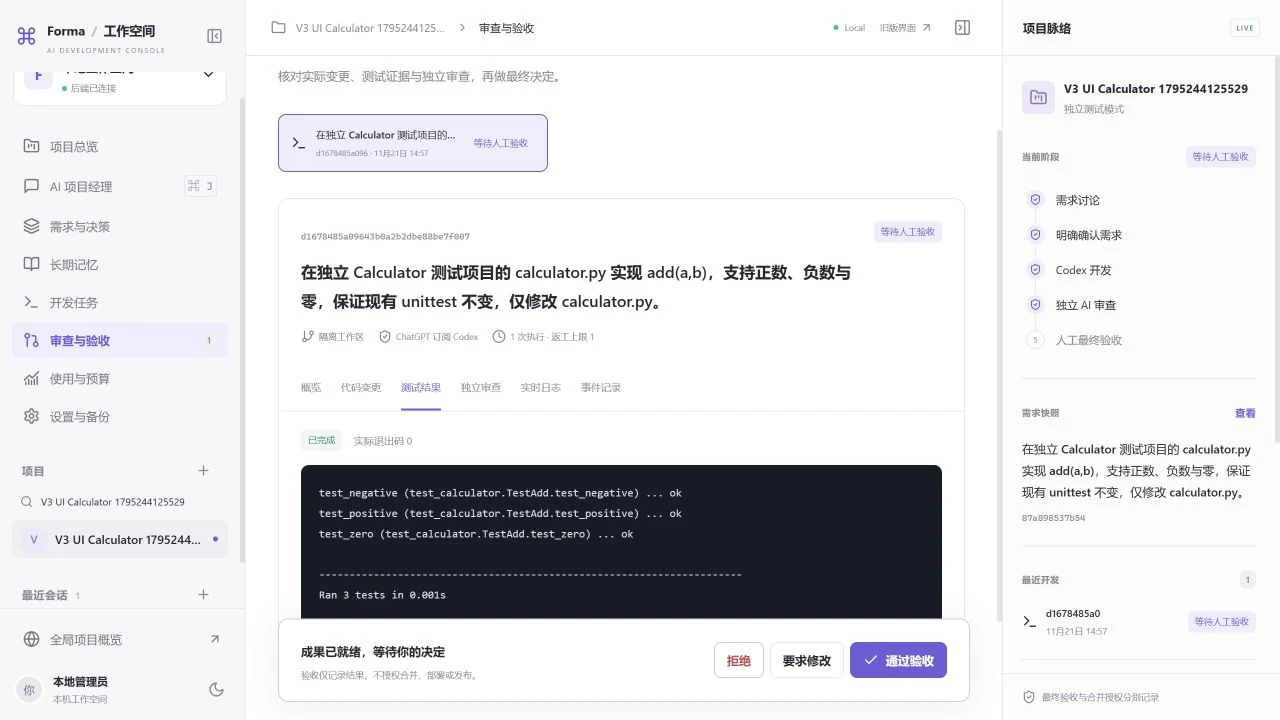
I used successive product versions to connect requirement clarification, task organization, authorized execution, change review and test records. The captured workbench shows a real calculator change from an unimplemented function to an addition function. Context isolation, history retrieval and rework flows are described in the resume; the retained evidence does not validate every scenario.
Technical Challenges
The main challenge is keeping scope, context and permissions consistent through multiple AI handoffs. Memory can surface irrelevant history; scheduling must preserve the requirement version; a successful test must not silently advance a task to human acceptance. These are separate validation problems, not one generic “agent success” metric.
Testing & Validation
Development included workflow testing, output review and troubleshooting.
Retained historical records are not newly executed original-product tests.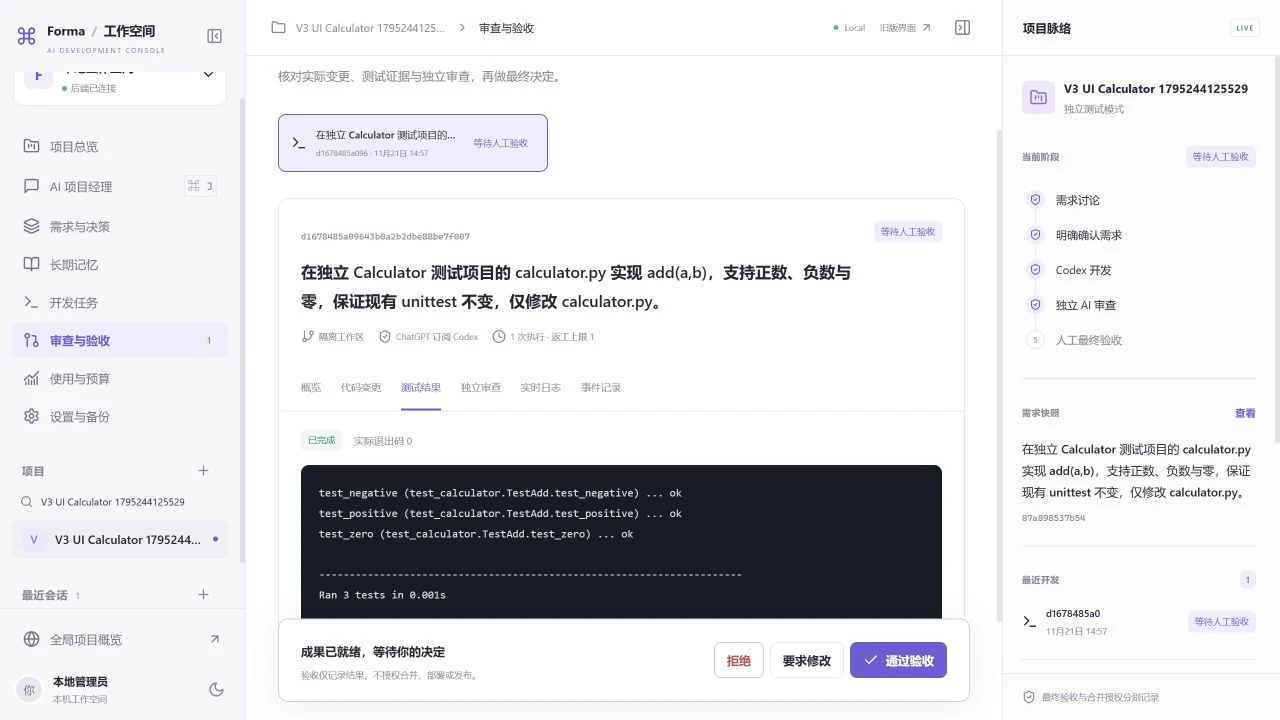
Results
Completed requirements, authorization and task scheduling, agent collaboration and codex execution, project context and long-term memory, code review, testing and human acceptance. The product is complete and usable.
Project dates follow the supplied resume; screenshots and recordings document the product at the time of capture.
Product Demo
- Requirements, authorization and task scheduling
- Agent collaboration and Codex execution
- Project context and long-term memory
- Code review, testing and human acceptance
Reserved for the real thing.
An original recording has not been supplied. Concept previews are not presented as running software or delivery evidence.
Show the work in action.
Project completion and usability confirmed by the portfolio owner. Screenshots and recordings retain their original capture context.
- Project console & requirement versions
- Codex execution & change records
- Test results & human acceptance
Lessons Learned
A useful design lesson is to treat scope confirmation, execution, test evidence and user acceptance as different states. For the next validation cycle, the priority is to test context contamination and requirement changes across tasks, then record a human UAT decision. These are follow-up checks, not reported completed improvements.